You pull up to your driveway, press the remote, and nothing happens. An automatic gate that won’t open is more than an inconvenience, especially when you are running late or trying to get home after a long day in the Inland Empire heat. The good news is that many of the reasons an electric gate stops working are simple to identify, and some you can even check yourself before calling for help.
This guide walks through the most common reasons an automatic gate will not open, the safe checks a homeowner can do, and the point where it is smarter (and safer) to bring in a professional. If you would rather skip straight to a fast fix, our team at Electra Gate Solutions serves Riverside, San Bernardino, Ontario, Rancho Cucamonga, Corona, Colton, and Moreno Valley with 24/7 service.
Start With the Power Supply
Before anything else, confirm the gate operator is actually getting power. It sounds obvious, but a loss of power is one of the most frequent reasons a gate suddenly stops responding. Inland Empire neighborhoods see their share of summer grid strain and the occasional outage, and a single tripped breaker can leave your gate dead.
Here are a few safe things you can check:
- Check the breaker. Find the circuit breaker that feeds your gate operator and make sure it has not tripped. Flip it fully off, then back on.
- Look for a blown fuse or GFCI outlet. Many operators plug into a GFCI outlet. Press the reset button if it has popped.
- Confirm the operator is plugged in. Vibration, landscaping work, or pests can loosen a connection over time.
- Check for solar or battery backup. If your gate runs on a solar panel or battery, a drained or aging battery may not hold a charge, especially after a stretch of cloudy days or extreme heat.
If power is clearly reaching the unit and the gate still will not move, the issue is likely deeper in the system. Anything involving exposed wiring, the main electrical panel, or hardwired connections should be left to a technician.
Inspect the Photo-Eye Sensors
Modern automatic gates use photo-eye safety sensors that stop the gate from closing on a vehicle, pet, or person. When these sensors are blocked, dirty, or knocked out of alignment, the gate may refuse to operate at all as a safety measure.
Walk down to the sensors, which usually sit low near the ground on each side of the gate opening, and look for:
- Dirt, dust, or spider webs on the lenses. Wipe them gently with a soft, dry cloth. The Inland Empire’s dust and wind can coat them quickly.
- Obstructions such as overgrown plants, trash cans, gravel, or parked items breaking the beam.
- Misalignment. If a sensor has been bumped, the two eyes may no longer line up. Many sensors have a small indicator light that signals when they are aligned correctly.
Clearing and realigning sensors is a reasonable DIY task. If they are cracked, water-damaged, or still not communicating after cleaning, replacement or rewiring is best handled by a pro.
Test the Remote, Keypad, and Receiver
Sometimes the gate itself is fine and the problem is how you are signaling it. Before assuming the worst, rule out the access controls.
- Replace the remote battery. A weak battery is the single most common remote failure. Swap it for a fresh one.
- Try a second remote or the keypad. If one device works and another does not, the issue is the device, not the gate.
- Stand closer. Range can drop as batteries age or if there is interference. Test from just a few feet away.
- Check the keypad code and wiring. Faded buttons, a wrong code, or a loose keypad connection can all block entry.
If every remote and the keypad fail at once, the receiver or control board inside the operator may be the real culprit. If your gate access control keeps failing, that is a sign the system needs a closer look.
Look for a Blocked, Off-Track, or Worn Gate
An electric gate is only as reliable as the hardware moving it. A motor can be in perfect health, but if the gate is physically stuck, it will not open.
Safely check for:
- Obstructions in the track. Rocks, dirt buildup, leaves, or debris can jam a sliding gate. Sweep the track clear.
- An off-track gate. Sliding gates can come off their rollers or guide rail, often after being forced or hit.
- Rust, bent hardware, or sagging. Hinges, rollers, and wheels wear out, particularly with daily use and year-round sun exposure common across Riverside and San Bernardino County.
- Worn or broken parts. Chains, belts, gears, and rollers all have a service life and eventually fail.
A quick sweep of the track is fine to do yourself. However, repositioning a heavy off-track gate, adjusting tension, or replacing worn drive components carries a real risk of injury and is best left to a technician with the right tools.
Control Board, Motor, and Weather Issues
If you have ruled out power, sensors, remotes, and obstructions, the trouble usually lives inside the operator itself.
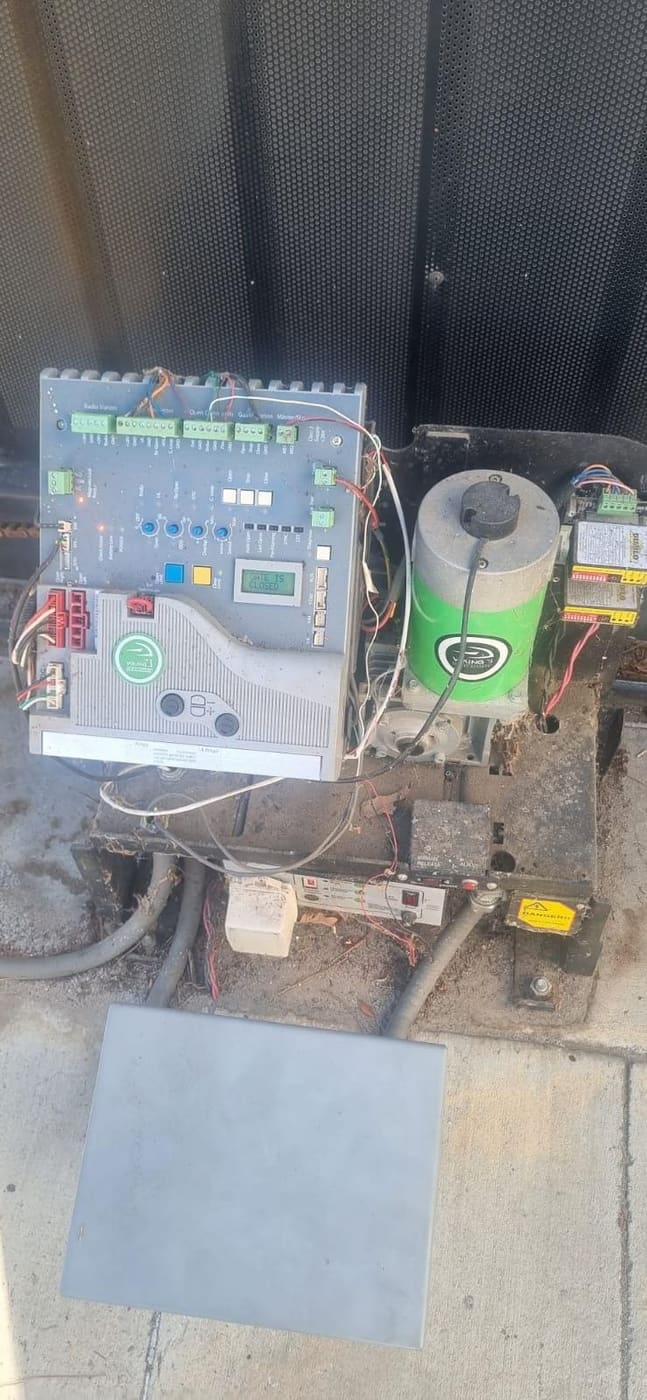
- Control board failure. The control board is the brain of the system. Power surges, water intrusion, age, and rodents can damage it. A board failure often shows up as a gate that has power but does not respond, makes clicking sounds, or behaves erratically.
- A dead or failing motor. If you hear humming but no movement, or nothing at all, the gate motor or operator may have burned out. Motor internals should never be opened by a homeowner.
- Weather effects. Extreme heat can cause components to expand and electronics to overheat, while rare cold snaps and rain can cause moisture issues. Heavy wind can blow debris into the path or knock sensors out of line.
Diagnosing a control board or motor calls for testing equipment, manufacturer knowledge, and safe handling of electrical components. This is the clear point to call an insured professional for electric gate repair.
When to Call a Professional
DIY checks are great for ruling out the simple stuff, but some repairs are genuinely unsafe to attempt at home. Call a pro right away if you encounter:
- Anything involving spring tension or hardwired electrical work
- A burned-out motor or suspected control board failure
- A heavy gate off its track or bent structural hardware
- Damaged wiring, scorch marks, or a burning smell
- A gate that opens or closes unpredictably, which is a safety hazard
Forcing a stuck gate or working around live electrical components can lead to serious injury and more expensive damage. A trained technician can diagnose the real cause quickly and get your gate working safely.
Frequently Asked Questions
Why does my electric gate have power but still won’t open?
When a gate has power but does not move, the cause is usually a blocked or misaligned photo-eye sensor, a failed control board, a worn drive component, or a burned-out motor. Start by cleaning and checking the sensors. If that does not solve it, the problem is likely inside the operator and should be inspected by a technician.
Can I open my automatic gate manually during a power outage?
Most automatic gates have a manual release that lets you disengage the operator and move the gate by hand during an outage. The exact method varies by model, and some require a key. If you are unsure how to release yours safely, it is best to have a professional show you or assist, so you do not damage the gate or hurt yourself.
How fast can you come out for an emergency gate repair in the Inland Empire?
Electra Gate Solutions offers 24/7 emergency service across Riverside, San Bernardino, Ontario, Rancho Cucamonga, Corona, Colton, and Moreno Valley. Response times depend on your location and the time of day, so the fastest way to get help is to call us directly and describe what your gate is doing.
Still stuck outside your own gate? You do not have to troubleshoot it alone. Electra Gate Solutions is fully insured and available around the clock for fast and emergency electric gate and garage door service throughout the Inland Empire, with a 5.0 rating from 57 reviews. We offer free quotes, plus discounts for new customers, seniors, and veterans. Call us today at (951) 903-5514 or request a free quote, and we will get your gate opening again.